Ekochem Plastics

LRA
pelletising lines
with agglomerators
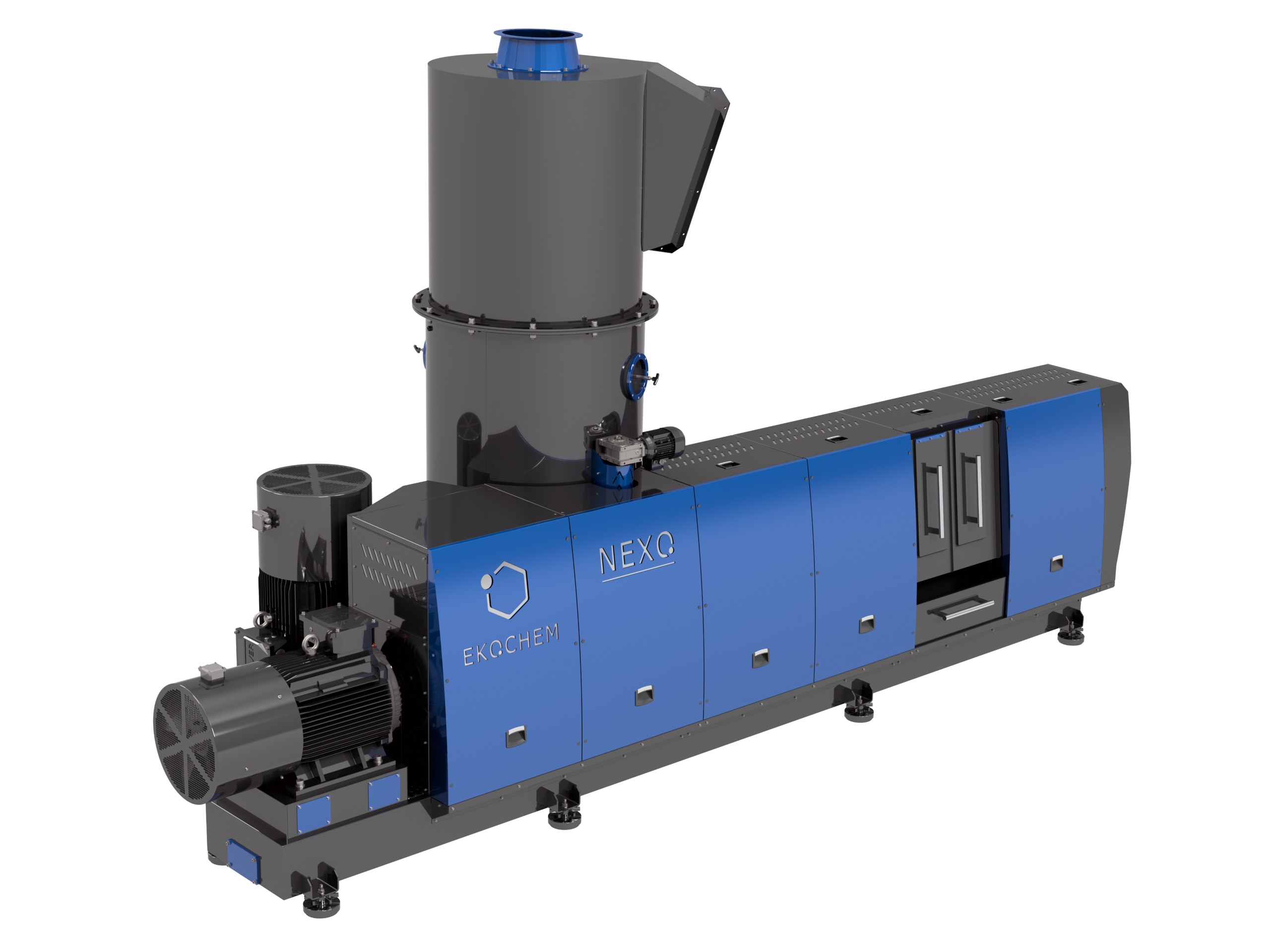
Linia do regranulacji plastuku odpadów przemysłowych SMART EKOCHEM
Optimised for the processing of plastics
LDPE
LLDPE
HDPE
PP
PS
EPS
Our pelletising lines with agglomerators enable the maximum use of foils and waste products. They support the closed-loop circulation of plastics and the policy of sustainable development, thus reducing the costs of waste disposal and easing the detrimental impact on the environment.
Specific Energy Consumption

0,38

kWh/kg
Lower unit production cost

25-30%

PLN/kg
VOC reduction via a specially designed degassing zone

by 40%

%
Consistency of process parameters

>95-99

%
Improved geometry of the plasticising system guarantees increased efficiency

>30

%
Energy efficiency
Production efficiency
Granulate quality
Automation
Economic and environmental aspects
PE waste products
Agglomerates
PP filament
Wires and cables
PP injection-moulded parts
Foils
PP
Agglomerates
PVC Recycling
Bulk Bags
EPS

LRA line key data

70–90% high automation level

The high automation level of the LRA line (up to 90%) significantly reduces manual labour, thereby minimising the human error factor and providing stability to the entire pelletising process. Automatic control over the key stages of the production process ensures consistent quality parameters of the granulated product, reduces response time to process changes, and lowers the unit production cost (PLN/kg). This results in higher predictability, lower need for manpower, and increased operational efficiency.

100% dedicated support

Each instance of LRA line installation comes with tailored and comprehensive support from Ekochem. Each customer is appointed a dedicated account manager who becomes responsible for the order from its acceptance until each problem is fully solved. This cooperation model reduces the response time, facilitates communication, and ensures continuity of production. This is no mere technical support, but a real partnership whose goal is to ensure a stable and efficient operation of a pelletising line.

Each 1 kg closed-loop material cycle

Our LRA line fully supports the implementation of a closed-loop material cycle at a production facility. Each kilogram of post-production waste may be efficiently recycled and reused with zero material loss and no additional waste generation. The results include lower costs of virgin material and disposal, as well as meeting the requirements of sustainable development and the ‘Zero Waste’ policy.

Twice the service life of the components

Components that are prone to fast wear and tear feature an improved design enabling operation in demanding industrial conditions. Their service life is up to twice as long as the standard ones, substantially reducing the replacement intervals and minimising unplanned downtime. Longer service life of components translates into lower running costs, higher line availability, and a stable, uninterrupted production process.
The numeric and financial data presented above have been calculated based on average industry values for the LRA machine option.

Parts/additional components

Aglomerator

Umożliwia efektywne zagęszczanie lekkich i trudnych w przetwarzaniu odpadów foliowych przed procesem regranulacji

HEADS

They come in two variants – water-ring die head and air-ring die head.

CONVEYOR BELT

Suitable for conveying agglomerates of cut film, agglomerated film sheets, or waste to the shredder hopper.

GRANULATE TRANSPORTING SYSTEM

Featuring an automatic material feeding, a material quantity sensor, and a dust removal system.

METAL DETECTOR

Prevents unwanted metal parts from entering the crusher or extruder.

🔧 LRA Line modules and configurations

LRA Pellet™ – the pelletising system is available in air-cooled or water-cooled versions, selected on the basis of the type of processed material and quality requirements of the granulated material. Ensures uniform granulation, stable line operation, and high consistency of the end product.
LRA RollFeed™RollFeedTM – a feeder for take-up winders, rolls, and film waste material, allowing for smooth and controlled feeding. Capable of operating simultaneously with the LRA TrimFeedTM module, ensuring continuous and uninterrupted production.
LRA Lift™™ – a feeding conveyor for loading loose, irregular waste directly into the shredder. Facilitates processing of materials of various fractions and automates the feeding stage, minimising operator’s manual labour.
LRA Screen™ – automatic screen replacement system for waste material processing. Ensures effective melt filtration and stable granulate quality, even when processing material with various levels of contamination.
LRA Vac™ – a dual-stage vacuum degassing machine for processing of printed, moist or hygroscopic materials. Effectively eliminates volatile fractions and smells while simultaneously improving the mechanical and aesthetic properties of granulate.
LRA Detect™ – a system of sensors providing real-time monitoring of the pelletising process, automatically detecting and reporting any irregularities in the line’s operation. Improves process safety, minimises risk of downtime, and ensures stable line operation.
LRA Control™ControlTM – an intuitive PLC control system with an easy-to-operate interface; designed for full control over the regranulation process. Provides a real-time monitoring of parameters, quick change of recipes, and remote maintenance, including diagnostics and technical support without the need for on-site maintenance.
LRA GateDetect™– a smart detection gate monitoring key points of the system’s operation and material flow. It automatically detects process irregularities (e.g., lack of material, blockages, unstable operation) and transmits data to the LRA ControlTM system, improving line's safety and reliability.

Characteristic features of the LRA line:

01

New generation compactor improving compaction efficiency by at least 30%

02

Sound insulation thanks to applying protective covers, ensuring a more hygienic and safer operation

03

Heat recovery and its use in the following stages

04

Automatic compactor gate valve

05

Efficient extraction of steam from the compactor

06

Dual temperature control system for the plasticising unit

07

Dual-stage vacuum degassing system

08

Automatic filtration of plastic material

09

Drives with the IE5 ultra-premium efficiency class

A complimentary and non-binding consultation is the first step in optimising your production process.
We answer each and every question and show the best course of action.

Contact us

Frequently Asked Questions

Our regranulation lines with an agglomerator are equipped with piston, plate or self-cleaning filters, depending on the material contamination level. Their efficiency depends on the configuration and the type of processed material: 80-150 kg/g in smaller lines, up to 1500-1800 kg/h in industrial models.

A line with a feed hopper is used for clean and bulk materials (e.g., regrinds), whereas an agglomerator feeds light and fluffy materials, such as foils or non-woven fabrics, in a stable way. Agglomerators compact and provide initial plasticisation of materials, facilitating their further processing.

Our offer includes different feed options: conveyor belts for regrinds, unwinders for foil rolls, and shredders for rigid waste. Everything depends on the type and form of waste.

Yes, we have references from installing our lines in Poland and abroad. Upon request, we can provide contact data to companies that use our solutions and can confirm their quality and reliability.

An agglomerator is recommended when processing light, fluffy or moist waste such as LDPE and LLDPE foils, stretch wraps, as well as non-woven fabrics and agricultural foil. It compacts processed materials, partially removes moisture, and ensures stable feeding to an extruder, which eliminates bridging and improves the line’s output.

Precise production and delivery dates are determined individually after the machine specifications have been approved. Please contact our technical and sales departments to estimate the lead time.

Standard efficiency levels are approx. 80-1500+ kg/h, depending on the type of plastics and filtration. Standard configuration includes: feeding → compactor/agglomerator → extruder with a 1-3 zone degassing system (also vacuum) → filtration (piston/plate/self-cleaning) → pelletising (strand/ring hot-face/underwater) → drying and collection of granulate.

Yes, our lines feature multi-stage protection against foreign objects. These include metal separators in the feeding zone, sensors monitoring the screw torque, and filters that capture contaminants. They minimise the risk of damaging the screw and the cylinder.

Compactor/agglomerator compacts light and fluffy materials, such as foils or non-woven fabrics, by increasing their temperature with heat generated by friction, providing initial plasticisation. As a result, the materials have lower moisture, higher density, and are fed to an extruder in a stable manner. This solution is highly recommended for LDPE and LLDPE foils, stretch wraps, as well as packaging and agricultural waste.

Our pelletising lines offer the output capacity of approx. 60 kg/h in pilot lines, and up to 2000 kg/h in industrial lines. The contamination levels depend on the filtration systems and configuration options, with clean processing (5% contamination content) in cascade lines with self-cleaning filters.